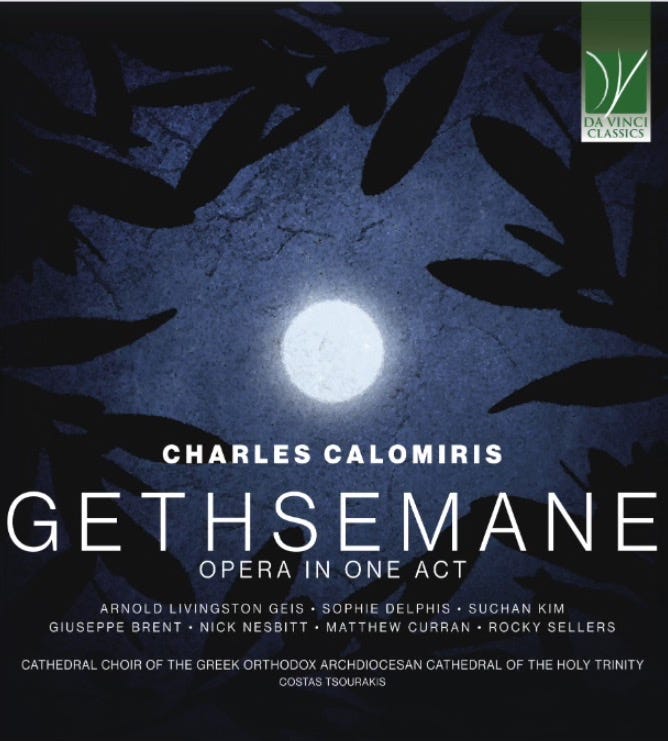
I am happy to report that our recently released DaVinci Classics recording of the opera, Gethsemane, is the subject of some kind words from listeners. In a March 31st review, Luigi Fertonani of Bresciaoggi writes (with translation):
The libretto presents what the Gospels do not say: the thoughts of Jesus, Satan trying to distract the Master from his mission, the agonizing doubts and the awareness of the suffering that will follow, the conversation with the Father; prayers, temptations, and doubts while his disciples fail to stay awake with him in prayer.
Christ takes shape thanks to the tenor Arnold Livingston Geis, while Calomiris gives the tempter Satan a high-pitched, feminine mezzo-soprano, that of Sophie Delphis; the voice of God is mysterious, with the dark timbre of the baritone Suchan Kim. The fresco is completed with the choir of the Orthodox Church of the Holy Trinity, conducted by Costas Tsourakis.
A bit brief and understated, perhaps, but being deemed worthy of a mention in a newspaper published in Brescia, only a stone’s throw from La Scala, works for me.
Canada’s Textura published a much longer review this month, which I found remarkably incisive in its understanding of my goals in writing the opera:
Gethsemane is a compact single-act work featuring six primary characters and a modest chamber ensemble of thirteen instruments. It’s tempting, perhaps, to think of it as more oratorio than opera (in fact, the composer himself describes the work as existing “at the boundary between secular drama and sacred oratorio”), and certainly it’s possible to imagine it stripped of its theatrical dimension and presented in a vocal concert format. The sterling treatment captured on this recording suggests that Gethsemane would be compelling regardless of the mode of presentation...
it…explores the general theme of sacrifice, Jesus’s lesson that, in the composer’s words, “mankind must learn sacrificial love to be reunited with God.” His climbing onto the cross not only overcomes death, it enables Jesus’s followers to understand what sacrifice means and what it achieves. Though the work is…compact, it nevertheless encompasses sweeping emotional terrain when it touches on beauty, pain, sacrifice, death, resurrection, and, binding them all, love.
…Gethsemane comprises ten parts and in time-honoured fashion begins with an instrumental overture that melodically foregrounds what follows. Gracefully entwining woodwinds and strings introduce the work, with harp, horns, and percussion joining thereafter. Despite its modest size, the ensemble more than capably highlights the contrasting moods and dramatic scope of the narrative to come in this engaging eight-minute opener.
…Addressing his disciples in the garden and expanding on his credo about loving one’s enemies, [Arnold Livingston] Geis makes his emotionally expressive vocal presence felt in the “The Golden Rule.” Jesus then leads them in the aria “Pray and Watch with Me,” the four collectively intoning the familiar words, “Love is patient, and love is kind”; however, as they do so, [Sophie] Delphis enters, her voice effective in distinguishing itself from the male voices, to make devilish contact with the disciples. During “The Only Sensible Choice,” Satan chidingly taunts Jesus, stating, “You should have listened in the desert / We would have made a great team,” and in featuring Delphis as the sole vocalist, the movement further amplifies her presence within the presentation. “Easy for him” again emphasizes Delphis, with rhythmic percussion and woodwinds magnifying the impact of her dynamic solo turn. After Satan exits, the stage is ceded to the Cathedral Choir, who in “Blessed” bring comfort to Jesus; having resumed praying to the Father, he then passionately delivers “Eli Eli Lama Sabachthani,” the desperation of his words “My God, My God, why have you forsaken me?” mirrored in the foreboding insistence of the music.
The Father’s response, with [Suchan] Kim stepping forth authoritatively, is for Jesus to save his people by climbing on to the cross. The opera ends, appropriately, with him alone in “Lift Me Up,” passionately embracing sacrifice, singing “Nail me to the tree of life so I can defeat hate” and emboldening his followers to find purpose and embrace life. While all of the performers elevate this performance, Geis and Delphis merit special mention for their outstanding vocal contributions. Musically, the work never sounds less than contemporary, but it also exudes a classical, time-transcending quality in extending itself stylistically into realms associated with Baroque and traditional Greek musics. There’s also an appealing formality to it that lends the piece the theatrical character of a ritual presentation or morality fable. Calling it both ancient and modern might seem contradictory, but that is, in fact, the tone this consistently gripping work achieves.
How encouraging! And I couldn’t agree more with the description of our performers, which reminds me how lucky I have been to work with the great vocalists and instrumentalists that appear on this album.



.avif)
.png)
.png)


.png)


.png)


.jpg)
