
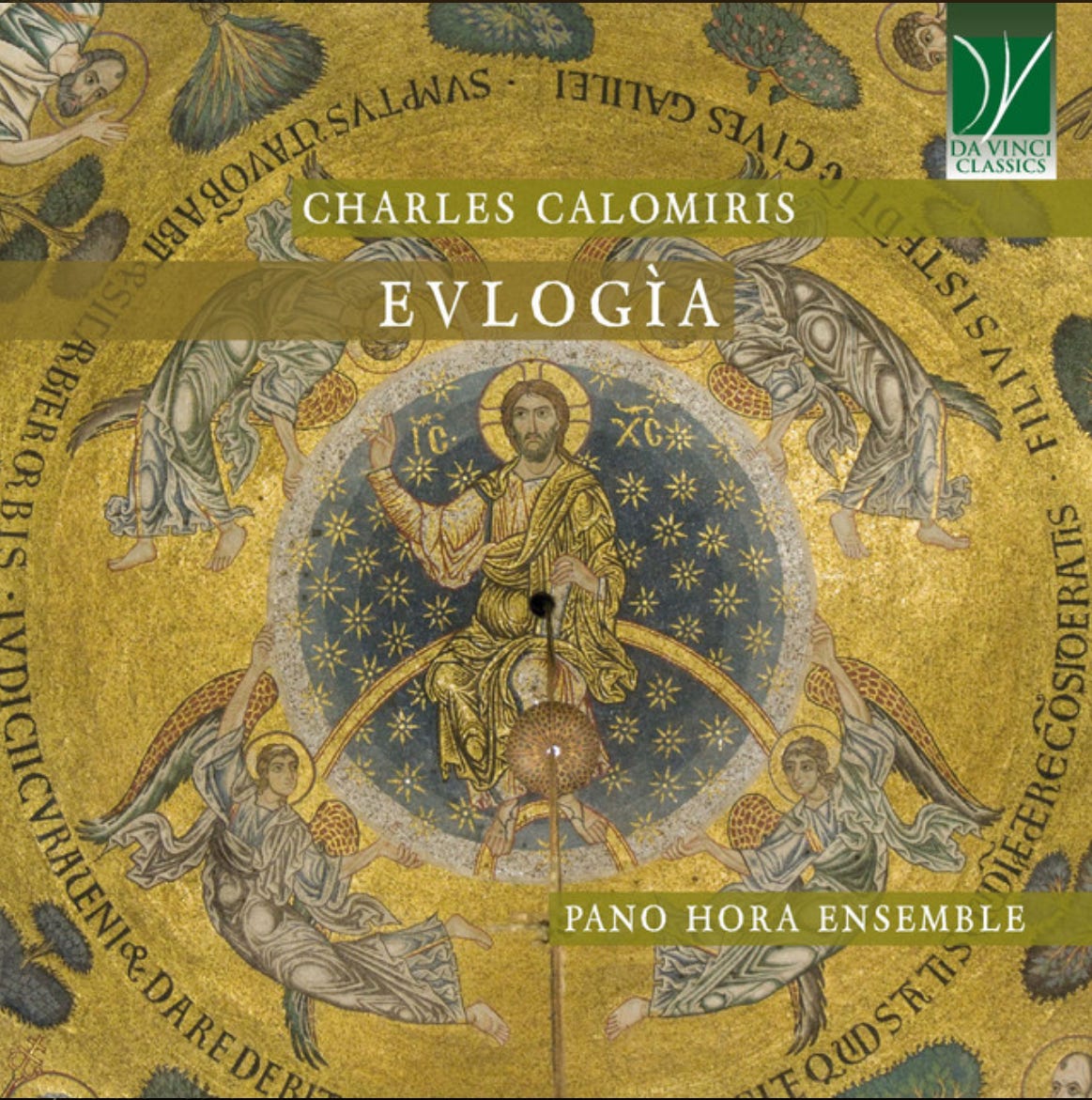
I am excited to announce the upcoming release by DaVinci Classics of the Pano Hora Ensemble’s recording of Gethsemane, an opera in one act which I wrote and produced. Readers of this blog may also recall that we are performing the world premiere of Gethsemane in Manhattan’s Merkin Hall on March 19 and 20 of 2027, which is a date change from a prior blog entitled, Save the Date! Two World Premieres. The March 2027 production of Gethsemane will also feature, in lieu of sets, original video material prepared by our team of iconographers and filmmakers, which you can get a glimpse of in a prior blog entry entitled, Gethsemane Projections. If you would like to read the program notes and libretto for the opera, they are also available on this website at the Project Page for Gethsemane, which also features one of the tracks from the opera, and a video of some of the iconographic images we will project at the performance in March of next year. Here is what the album cover looks like:
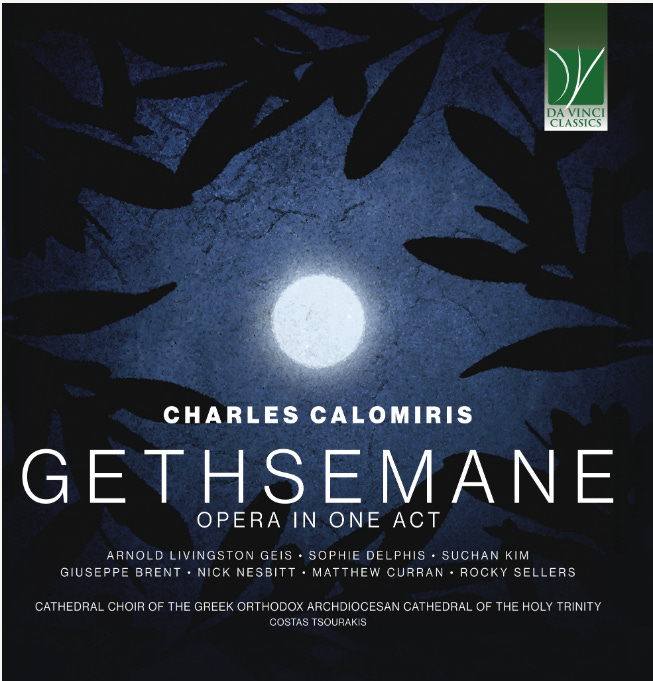
Gethsemane is intended to exist at the boundary between secular drama and sacred oratorio. It takes place entirely in the hour before Jesus is seized in the Garden of Gethsemane, where he has gone with his three leading disciples, Peter, John, and James. The opera is not an oratorio because, unlike The Messiah or the Passions of St. John or St. Matthew, or the Requiems written by many composers, it is not a rendering of sacred text, although it does contain passages from the Bible. Neither is it a musical akin to Jesus Christ Superstar or Godspell.
As much as I love all those works, my intent is different: it is to create an original textual and musical interpretation of the last hour Jesus spends in the Garden of Gethsemane, just before he is seized, which incorporates the supernatural aspects of that story, which I would say are central to its meaning. In that sense it is akin to other works and performances that belong to the Orthodox Christian tradition of reenactment. Every year, in the days leading up to Pascha (Easter), Orthodox Christians attend church services that relive the events that took place from the raising of Lazarus on the Saturday before Palm Sunday to Jesus’s Resurrection on Easter Sunday. Those liturgical services follow Jesus from his visit to Lazarus’s tomb, to his entry into Jerusalem, to the Last Supper, Judas’s betrayal and the seizure in Gethsemane, to Jesus’s meetings with Herod, the Council, and Pilate, ending in his crucifixion, death, burial, and resurrection. Additionally, some Orthodox communities also have been known to stage dramatic reenactments of some of these events, as recounted in Nikos Kazantzakis’s novel, The Greek Passion.
Gethsemane, like those dramatic reenactments, is a secular work that seeks to come to grips with questions that cannot be discerned directly from scripture or church services. But unlike Jesus Christ Superstar or Godspell it examines the moment in Gethsemane from the perspective of Christian understanding, which includes supernatural elements. Jesus Christ Superstar and Godspell recount events from the New Testament, but do so in a “neutral” way; they do not contain any references to supernatural occurrences, to Jesus’s conversation with His Father, or to His Resurrection. That is not a criticism; I can see the value in that approach, which makes the subject matter accessible to many people who otherwise might not be receptive to it. And those musicals were great art, with significant impact on many listeners.
But it seemed to me worthwhile to use the medium of opera to approach some questions that those works left untouched because they omitted supernatural references. After all, theatres and opera companies regularly perform works that creatively explore the content of supernatural themes, including light works such as Shakespeare’s A Midsummer Night’s Dream, explorations of myths, which include many of Wagner’s operas, and works with Biblical or religious references, such as Saint-Saëns’ Samson and Delilah, Verdi’s Don Carlo, and many more.
My interest began by noticing that there is scant scriptural evidence about the details of how Jesus passes his last hour in Gethsemane. Do his three top disciples who are present with him there ask him questions, and if so, how does he respond to them? We are told that Jesus prays to his Father, and we know from the Bible something about what Jesus says in those prayers, but not much. Neither does the Bible tell us what his Father says to Jesus in response. Are others present in Gethsemane? Possibly the heavenly host of angels come to comfort Jesus. If so, what do they say to him? Does Satan attempt to converse with Jesus in Gethsemane? If so, what does Satan understand about Jesus’s intentions, and what might he want to accomplish by such a conversation? How can Satan possibly convince Judas, who has walked alongside Jesus for three years and witnessed his many miracles, to betray Jesus by leading a band of soldiers to Gethsemane to seize him?
Gethsemane proposes answers to those questions, which are not based upon scripture or church tradition, and which can only be addressed within the context of the supernatural. The opera’s theme, like the Orthodox reenactment of Holy Week, is the centrality and radical nature of Jesus’s lesson that mankind must learn sacrificial love to be reunited with God. Sacrificial love is not imaginable prior to the Crucifixion—not to Satan, nor to Jesus’s disciples (who see it as an obstacle to gaining followers, and who confuse it with weakness). Jesus’s decision to climb onto the cross not only accomplishes the objective of overcoming death for us, it makes it possible for us to understand and imitate his teaching of sacrificial love.
Although the plot of Gethsemane is not based mainly on scripture, it is consistent with scripture, and is not merely an artistic exercise, but rather a reflection of faith. Although I see the great value in works such as Jesus Christ Superstar or Godspell, I also recognize that they can encourage the view that Jesus as a historical figure can be understood and embraced as a virtuous and wise person, without any need to make reference to the supernatural events recounted in the Bible. That view is incorrect because it misses the central purpose of Jesus’s ministry, which culminates in his Resurrection. Furthermore, the modern attempt in some quarters to accept some of Jesus’s teachings without reference to the supernatural – seeing him as one of many great teachers or philosophers – simply is not tenable. As Lee Strobel points out in his painstaking scholarly work, The Case for Christ, any historically defensible understanding of Jesus and his movement has to choose between viewing him either as a charlatan/madman, or as the Son of God. As C.S. Lewis famously wrote in Mere Christianity (Macmillan-Collier 1960, pp. 55-56):
I am trying here to prevent anyone saying the really foolish thing that people often say about Him: “I’m ready to accept Jesus as a great moral teacher, but I don’t accept His claim to be God.” That is the one thing we must not say. A man who was merely a man and said the sort of things Jesus said would not be a great moral teacher. He would either be a lunatic…or else he would be the Devil of Hell. You must make your choice. Either this man was, and is, the Son of God: or else a madman or something worse. You can shut Him up for a fool, you can spit at Him and kill Him as a demon; or you can fall at His feet and call Him Lord and God. But let us not come with any patronizing nonsense about His being a great human teacher. He has not left that open to us. He did not intend to.
Gethsemane is about a time for choosing in which all of us can participate, an ever-present where past and future coexist, visible and undivided, where creation, joy, beauty, pain, sacrifice, death, and resurrection reveal the loving thread that knits them together. I hope you will give it a listen.




.avif)
.png)


.png)


.png)


.png)


.jpg)
